Google Quantum Echoes Algorithm Runs 13,000x Faster Than the World's Best Supercomputer
0:00 / 1:17
News
Google Quantum Echoes Algorithm Runs 13,000x Faster Than the World's Best Supercomputer
calendar_today Date:
schedule Duration: 1:17
visibility Views: 19
database
Summary Report
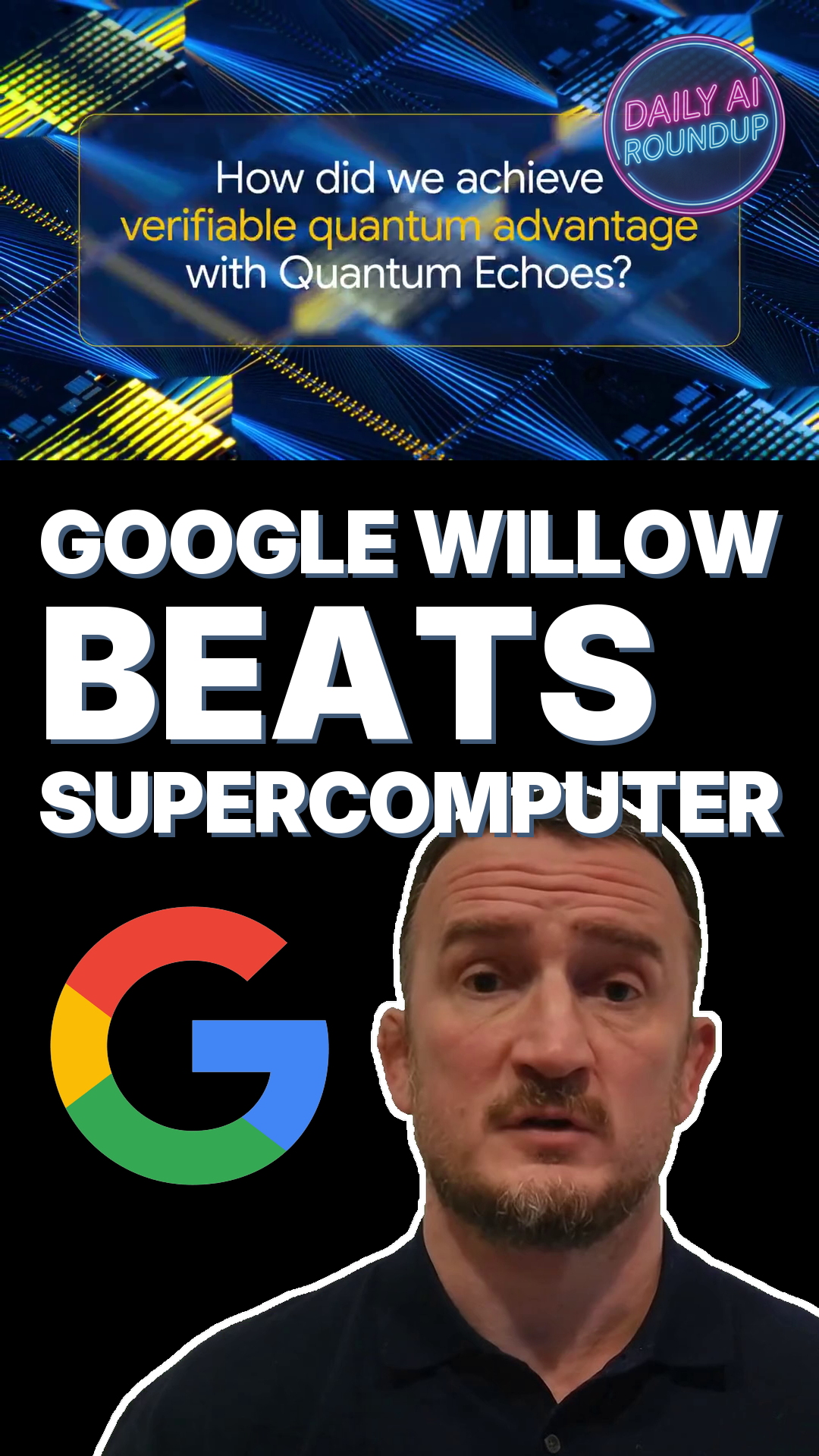
Google's Quantum Echoes algorithm on the Willow chip is the first verifiable quantum advantage, finishing a physics simulation 13,000x faster than the best classical supercomputer.
- 01. Google Quantum AI ran the Quantum Echoes algorithm on its 105-qubit Willow chip 13,000 times faster than the best classical supercomputer.
- 02. The algorithm is an out-of-time-order correlator that probes how information spreads through a quantum system.
- 03. It is the first quantum advantage result that can be independently verified by re-running on another quantum machine of the same calibre.
- 04. Practical applications target the structure of natural systems - molecules, magnets, even black holes.
- 05. Marks a shift from benchmark-only quantum demos toward real scientific tools.
Google Quantum AI has achieved a significant milestone by demonstrating the first verifiable quantum algorithm that outperforms classical supercomputers. The Quantum Echoes algorithm, running on Google's 105-qubit Willow processor, completed a physics simulation 13,000 times faster than the world's most powerful classical machines.
The algorithm functions as an out-of-time-order correlator, a specialised tool used to examine how information spreads through quantum systems. What sets this achievement apart from previous quantum advantage claims is its verifiability—the algorithm can be reproduced on any quantum computer of similar capability, and the results remain consistent across runs. This reproducibility addresses longstanding concerns about earlier quantum computing demonstrations that relied on tasks impossible to verify independently.
The breakthrough has significant implications for scientific modelling, particularly in simulating natural systems that classical computers struggle to handle effectively. These include complex molecular interactions, magnetic systems, and even theoretical models of black holes. The ability to accurately simulate such systems could accelerate research across multiple scientific disciplines.
If this verifiable quantum advantage can be maintained and scaled up, it represents a pivotal moment for quantum computing technology. Rather than remaining a theoretical benchmark exercise, quantum computers could transition into practical scientific tools capable of solving real-world problems that are currently beyond the reach of classical computation.
Meta Data
Company: