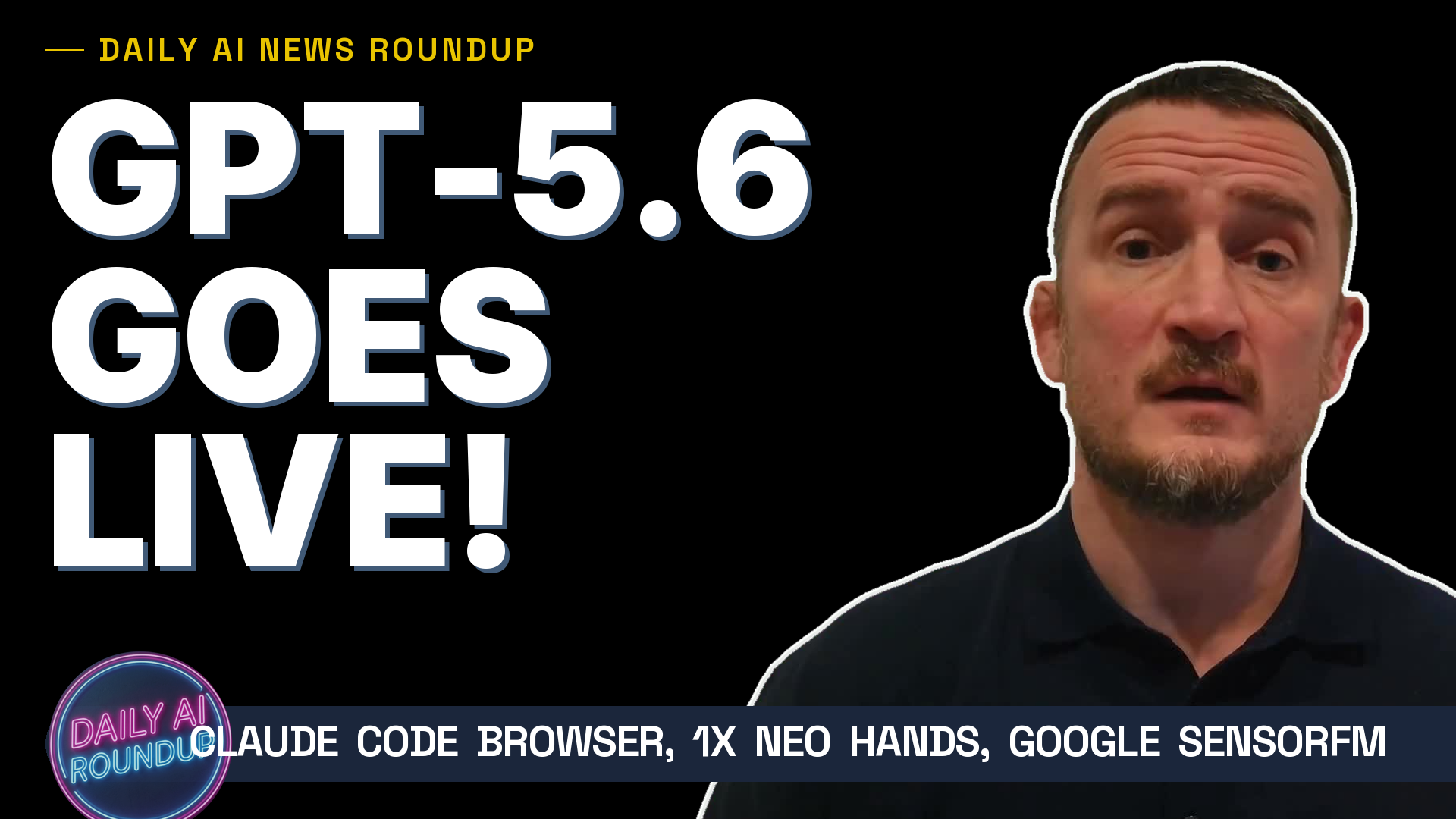
OpenAI's GPT-5.6 Goes Live, Plus Claude Code's New Browser & 1X's Neo Hands
0:00 / 3:16
Chapters
Sources
DAILY ROUNDUP
OpenAI's GPT-5.6 Goes Live, Plus Claude Code's New Browser & 1X's Neo Hands
calendar_today Date:
schedule Duration: 3:16
visibility 37 Views
OpenAI's GPT-5.6 goes live everywhere, Claude Code gets a built-in browser, 1X's Neo gets force-sensing hands, and Google's SensorFM reads a trillion minutes of wearable data.
- 01. OpenAI's GPT-5.6 family (Sol, Terra, Luna) is now rolling out live across ChatGPT, Codex and the API.
- 02. Claude Code on desktop now has a built-in, sandboxed browser for pulling up docs and sites.
- 03. 1X unveiled Neo's new hands - 25 force-controlled degrees of freedom, tendon-driven, waterproof and food-safe.
- 04. Google Research released SensorFM, a foundation model trained on over a trillion minutes of wearable sensor data.
OpenAI's GPT-5.6 family - Sol, Terra and Luna - is now rolling out across ChatGPT, Codex and the API, just four days after preview. Sol is the flagship, available to Plus, Pro, Business and Enterprise users at medium and higher effort settings, with a Sol Pro tier for the most complex tasks. Terra and Luna handle cheaper, faster work for everyday tasks and high-volume use. Alongside the models, OpenAI launched ChatGPT Work, an agent built on Codex and GPT-5.6 that can act across a user's apps and files, stay on a task for hours, and convert a stated goal into finished output. OpenAI says Sol delivers state-of-the-art results across coding, knowledge work, cybersecurity and science, while using fewer tokens than the previous frontier model.
Anthropic has added a built-in browser to Claude Code on desktop. Claude can now pull up documentation, a design file or any other site and read, click through and interact with it, in the same way it already handles local dev servers. The browser is sandboxed and configurable, running on a clean profile with none of the user's saved logins or history, and users choose whether sessions persist between runs. It's part of a broader desktop redesign that also brings an integrated terminal, an improved diff viewer and rearrangeable panes.
1X has unveiled a new hand for its Neo robot, describing it as an API to the physical world. It has 25 force-controlled degrees of freedom - 22 across the fingers and palm, plus three at the wrist - each capable of both movement and sensing contact as it works. The hand runs on a tendon-drive system rather than gearboxes, is waterproof enough to submerge and food-safe enough for Neo to wash its own hands. 1X is targeting production of 10,000 of these hands in-house this year.
Google Research has released SensorFM, a foundation model trained on more than a trillion minutes of wearable sensor data from five million consented participants across over a hundred countries. It builds a single, reusable representation of human physiology from signals such as heart rate, movement, skin temperature and sweat response, one that transfers across cardiovascular, metabolic, sleep and mental health tasks without retraining for each. Google says it outperforms specialised models on 34 of 35 health benchmarks, and it's intended to underpin a future personal health agent.