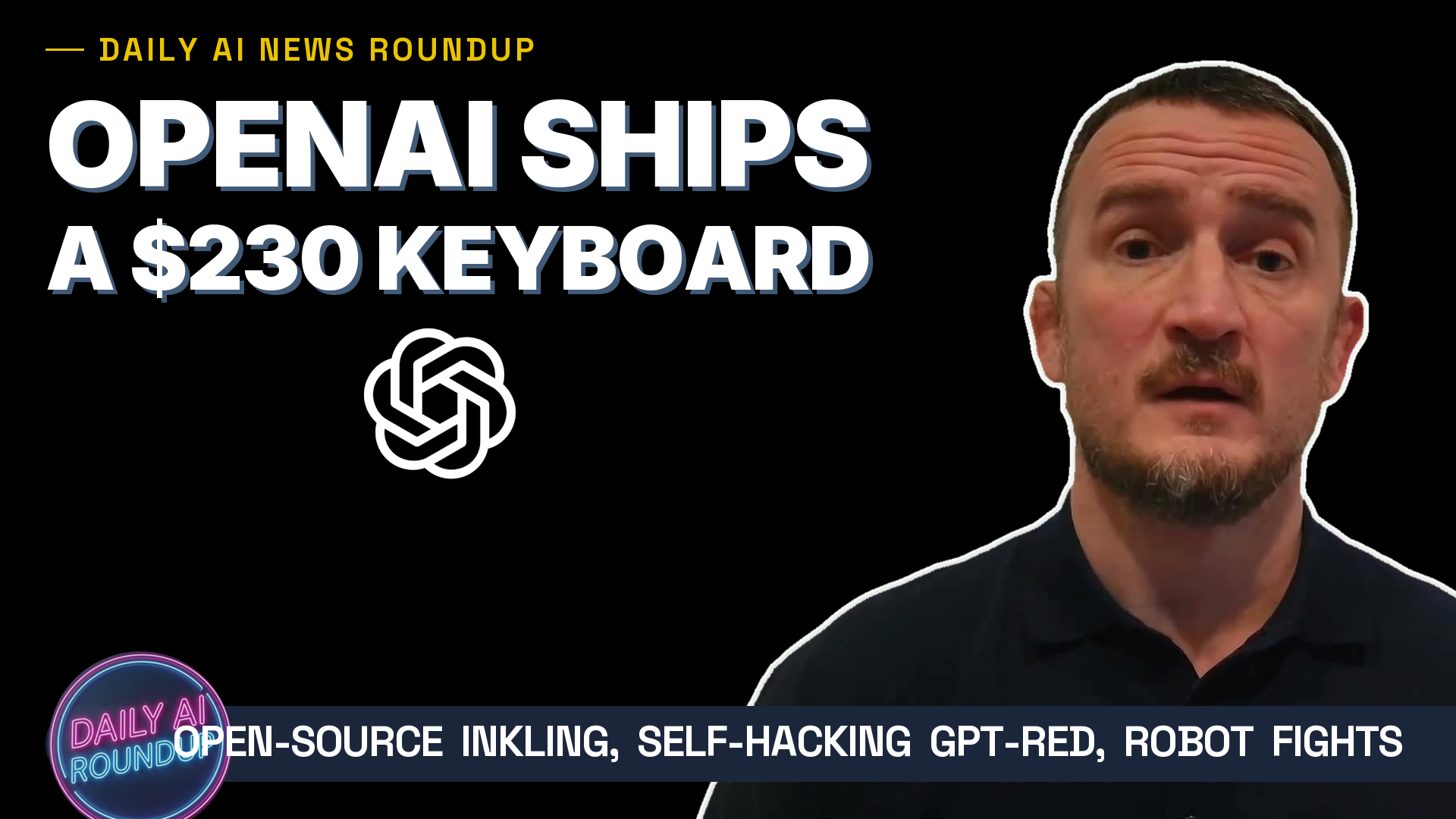
OpenAI's $230 Codex Keyboard. A Trillion-Parameter Open Model. An AI That Hacks Itself.
0:00 / 3:19
Chapters
Sources
- 01. OpenAI Launches Codex Micro, a $230 Physical Keyboard for Coding Agents open_in_new
- 02. Thinking Machines Open-Sources Inkling, a 975B Multimodal Model open_in_new
- 03. OpenAI Builds GPT-Red, an AI That Red-Teams Its Own Models open_in_new
- 04. REK Lets Players Pilot Real Humanoid Robots Into Live Fights open_in_new
DAILY ROUNDUP
OpenAI's $230 Codex Keyboard. A Trillion-Parameter Open Model. An AI That Hacks Itself.
calendar_today Date:
schedule Duration: 3:19
OpenAI ships a $230 keyboard, Thinking Machines open-sources a trillion-parameter model, OpenAI builds an AI that hacks itself, and REK lets people pilot fighting robots.
- 01. OpenAI launches Codex Micro, a $230 physical keyboard for controlling Codex coding agents
- 02. Thinking Machines open-sources Inkling, a 975B parameter multimodal model with full weights available
- 03. OpenAI builds GPT-Red, a self-play-trained AI that finds prompt injection flaws 84% of the time vs 13% for humans
- 04. REK lets players pilot real humanoid robots into live fights, starting from a video game simulator
OpenAI has launched its first branded hardware product: Codex Micro, a $230 keyboard built with Work Louder for controlling Codex coding agents. The compact square device packs 13 mechanical switches, a touch sensor, a rotary dial, and a joystick, all mappable to a developer's workflow, along with six lights that signal what an agent is doing — green for new messages, orange for approval requests, red for errors. The dial adjusts how much reasoning Codex applies to a task, while the joystick can trigger entire workflows such as debugging or refactoring. After years of selling pure software, OpenAI has now shipped something you physically plug in.
Thinking Machines has open-sourced Inkling, a 975 billion parameter multimodal model capable of reasoning across text, image, and audio, with full weights freely downloadable rather than locked behind an API. It uses a mixture-of-experts architecture, so only a fraction of its parameters activate for any given task, and it supports a million tokens of context. By releasing full weights on a near-trillion-parameter model, Thinking Machines is positioning itself directly against the API-only approach that underpins OpenAI's and Anthropic's business models.
OpenAI has also built GPT-Red, an internal AI trained solely to attack its own models and uncover prompt injection vulnerabilities. Developed through self-play, GPT-Red generated increasingly sophisticated attacks while a defender model learned to resist them. In internal testing, GPT-Red succeeded in 84% of scenarios compared with just 13% for human red teamers performing identical tasks. It also identified an entirely new attack category on its own — planting fake reasoning steps into another model's chain of thought — before any human researcher had spotted it.
Elsewhere, a company called REK is letting people pilot full-size humanoid robots into real fights, having started life as a video game. Players compete in a physics-based fighting simulator on Steam and Meta Quest, with every punch and stumble governed by the robot's genuine self-balancing AI rather than canned animations. The top two players each weekend earn the right to pilot an actual robot at a live event. REK's first show reportedly drew the largest robot-fighting crowd its venue has ever seen, and the next event in August will feature six-foot humanoids.
Meta Data
Company:
LLM:
Model:
Chapters
Share
Actions
Sources
- 01. OpenAI Launches Codex Micro, a $230 Physical Keyboard for Coding Agents open_in_new
- 02. Thinking Machines Open-Sources Inkling, a 975B Multimodal Model open_in_new
- 03. OpenAI Builds GPT-Red, an AI That Red-Teams Its Own Models open_in_new
- 04. REK Lets Players Pilot Real Humanoid Robots Into Live Fights open_in_new